 |
| Reputed marble bust of Hannibal |
The greatest generals from history, rather, have conquered the need to adapt to uncertainty in battle. At the apex of skill they strike in force and at the desired time when Chaos extends her hand to offer the willing general a chance to grab a decisive victory. Napoleon's victory at Austerlitz was brilliant for his management of uncertainty. His abandonement of the battlefield's central focus, the Pratzen Heights, in order to tempt his enemy, the Tsar Nicolas, to overextend himself worked because Napoleon expected the Tsar's eagerness for glory. By moving up the hill, Nicolas exposed the center of the Russian battle-line to attack and, yes, this sequence of events was planned by Napoleon. But while French victory was more or less secured after Napoleon struck back at the Heights, it was Napoleon's genius coupled with the professionalism and adaptability of his army that won the battle thereafter, not his battle plan alone. Likewise, Alexander fashioned a battle plan at Guagemela which was tailor-made for his army's strengths and which was an answer to Darius' overwhelming advantage in number of troops. But how far Alexander and his Companion Cavalry rode out past the Macedonian right flank, or what was the most opportune moment to about-face his shock cavalry unit to pierce the Persian line -- both of these considerations could never be known while Alexander crafted his strategy.
In other words any strategic plan, if it is to succeed, must survive the shock and friction of the actual battle. That was an idea most clearly articulated by von Clausewitz: theoretical plans are always more difficult to implement in the real word because of friction, or the gradual loss of both energy and momentum of an army while it acts. Napoleon and Alexander both achieved masterful victories at Austerlitz and Guagemela, respectively, not only because they had the tactical skill to overcome battlefield friction, but also because their original plans were sound. They considered chance as an operating force upon the outcome of their battles and deployed their forces in such a way as to invite chaos and the opportunities that present themselves.
Which brings us to Hannibal's overwhelming victory at the Battle of Cannae in 216BC. Arguably the most impressive victory in history, Hannibal's pre-battle strategy and the actual implementation of that strategy at the tactical level were nearly identical. For all intents and purposes, Hannibal achieved perfection. Here's how he did it.
Quickly, Hannibal Barca, the son of Hamilcar Barca, the leading but tragic general during the First Punic War (264-241BC), was born in what is today Tunisia on the North African coast. He was raised, however, in southern Iberia, today's Spain, and he was raised with one goal in mind: to destroy the Romans. He grew up fast living amongst soldiers loyal to his father; crack Libyan infantrymen, Numidian horsemen, and Spanish mercenaries. He inherited this professional Carthaginian army after his father died in battle and after his brother-in-law, Hasdrubal, was assassinated by Spanish chieftains. Worshipped as a demi-god by the army, Hannibal's early command of his army made quick and ruthless work of the guilty Spanish nobles, and he either recruited their followers or simply sent them home.
His legacy began as he and his army initiated the Second Punic War with Rome (218-201BC) after sacking a local city, Seguntum, which was allied with Rome. Knowing full well that the Roman navy controlled the Mediterranean, and eager for glory and revenge, Hannibal secured the most effective defensive posture against Rome's eventual retaliatory invasion of either Spain or Carthage: he went on the offensive and marched his gigantic army through Spain, across the Pyrenees and into Gaul before vanishing into the Alps during winter! After losing roughly half of his army from the cold and desertion, Hannibal and his men emerged from the Alpine passes and marched into the Po Valley on Italian soil. Thankfully, the Romans were completely surprised upon his arrival and this allowed Hannibal enough time to rest his army and to recruit local Gaul mercenaries who belonged to tribes who had long chaffed under the repressive Roman yoke.
 |
| Hannibal's Invasion Route |
Hannibal sought a decisive battle at Cannae because he was confident of the conclusions he had reached while using the same logic he employed when he first decided to invade mainland Italy. The only guaranteed way to bring Rome to its knees, or so Hannibal believed, was to draw out her armies and to defeat them in pitched battles in order to sap the city of its true power. After Rome had suffered a number of crushing defeats, Hannibal reasoned, her local allies -- who were nominal allies at most -- would abandon her to join Carthage's struggle in the hopes of regaining their freedom from Roman overlordship.
The battle took place in Apulia in southeast Italy during August when the air is dry and the ground dusty. The two Roman Consuls for the year, or elected military executives, were Lucius Aemilius Paullus and Gaius Tarentius Varro. The latter was a fire-breathing war-hawk who, like Hannibal, sought nothing else but a decisive, pitched battle but lacked the strategic acumen which Hannibal had developed over the years. Varro and Paullus marched their respective legionary armies to Cannae and camped on either side of the Aufidius river. Roman custom held that if two Consuls occupied the same battlefield then they had two choices of that battle's command: (1) each would command his respective army as they combined forces as one overwhelming unit; or (2) each Consul would command all of the troops on alternating days. They chose the second option, and on the day of battle it was Varro's turn to lead the troops. No one, except for Hannibal of course, knew that it was towards a hellish and gruesome fate that the Roman's would be led to while following Varro's leadership.
In approximate terms, the Carthaginian army numbered around 50,000 men sub-divided into 32,000 heavy infantry, 8,000 light infantry, and 10,000 cavalry. The Romans overwhelmingly outnumbered Hannibal's forces: roughly 86,000 men filled their ranks sub-divided into 40,000 Roman infantry, 40,000 allied infantry, and roughly 6,000 cavalry. This superiority would serve as the deciding factor for Varro's strategic decision making process. He decided to mass his legionnaires closer together than usual at both the individual level and the manipular level (a maniple numbered 120 men for the first two groups, 60 for the third, and 60 maniples made a Legion) in order to punch through the center of Hannibal's line thereby dividing a weaker force in the face of numerical superiority. Hannibal was aware of Varro's aggressive tactics, expected a heavy thrust towards the center of his line, but, ironically, was hoping for this very outcome.
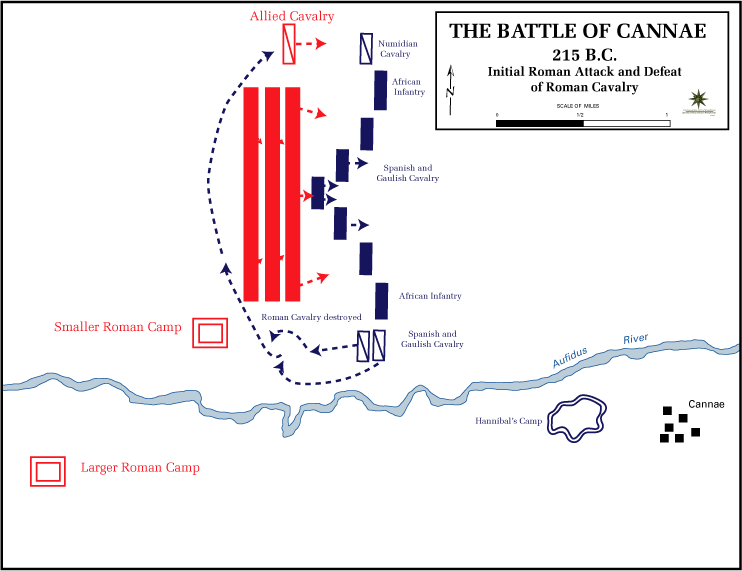
Hannibal arrayed his battle-line in a crescent shape, or a bow-like shape with the center of his line closest to the Romans while his right and left flanks were in echelon backwards.
 |
| Notice the Carthaginian battle-line, in blue, angled backwards to invite the Roman attack. |
As the tightly packed Roman infantry line pushed ever forward into Hannibal's line, the crescent shape of the Carthaginian army began to reorient itself to face inwards instead of outwards. In other words, while Hannibal's right and left infantry flanks stood still, and while his center steadily fell backwards, the Romans carved out for themselves a pocket into which they ceaselessly marched. Eventually the bow-like shape faced inwards and the Romans were suddenly surrounded on three sides. While the Roman Legion was more flexible than most armies of its day, no army could withstand three prolonged, simultaneous attacks upon its front line, and its right and left flanks.
Before the developing infantry scenario is played out, however, we must turn to the cavalries of both armies, positioned on either flank of the battlefield, so that we can more easily understand the bloody climax to the battle.
 |
| Phase II at Cannae. Hannibal's crescent, bow-like line flips inwards to outflank the headstrong Roman infantry |
Hannibal's Spanish and Gaulish cavalry mercenaries stood on his left flank opposite the Roman cavalry. The Romans, in addition to never respecting the efficacy of cavalry in battle, were outnumbered on this side of the field. The other side of the battle pitted Hannibal's Numidian cavalry -- undoubtedly the known world's most deadly horsemen -- against the Roman auxiliary cavalry. Crucially, Hannibal instructed his cavalry on the army's left flank to quickly and assuredly drive their combatants from the field. They did this. And then they flew behind and around the infantry battle to support their Numidian confederates. Keep in mind, this was part of Hannibal's original plan.
After defeating all Roman cavalry units and driving them from the field, the now combined forces of Carthaginian cavalry -- numbering probably 7,500-8,000 after their initial combat -- wheeled round 180 degrees and charged headlong into the backs of the Roman infantry. This last maneuver, also planned, snapped the lid shut on the now panicking Roman foot soldiers.
This is very important. Before the Carthaginians fully enveloped the Roman infantrymen, Rome and her allies had begun to experience a high rate of casualties, but a large majority of the original army's strength was still fighting on the field. The slaughter which ensued, however, upon the arrival of the Carthaginian cavalry has rarely, if ever, been equalled in history for its ferocity or for its mechanical precision.
The Romans were still grouped tightly together and therefore were suffering from a small perimeter, a constricted surface area upon which they could deploy their forces. Think of the U.S. 101st Airborne Division's defense of Bastogne against the German army during the Second World War. The U.S. paratroopers chose not to position their firing line in the town proper because doing so would restrict the range of fire they hoped to secure. Instead they defended the town's outskirts so as to efficiently maximize each soldier's potential to fire down and across range. At Cannae the Romans suffered under their own mass as they were prohibited from deploying an adequate portion of their entire force.
For hours the Carthaginians hacked away at the outer shell of the shrinking Roman blob. We are told that most soldiers were prevented from even lifting their shields or swords to defend themselves. Most died at the hands of their enemies, but others suffocated to death in the mob's crush, and a significant number of soldiers chose to kill themselves in a clean fashion. After hours of this horrendous slaughter Rome and her allies suffered, approximately, 54,000-75,000 deaths, depending on the historical source. What a horrible scene it must have been.
Hannibal outwitted his opposing general, outmaneuvered his adversary's troops, and, through sheer gravitas, convinced a large portion of his men to do the impossible. His double-envelopment strategy was and still is marveled at today as a battlefield masterpiece. During the outbreak of the Second World War Nazi Germany unleashed its "Lighting War," or Blitzkrieg. Crafted and championed by Field Marshal Heinz Guderian, the German armored onslaught through Poland, Denmark, the Netherlands, Belgium, and -- most spectacularly -- France was a modern, direct adaptation of Hannibal's envelopment maneuvers at Cannae. More recently, U.S. Army General "Stormin'" Norman Schwarzkopf deployed coalition armored divisions into sweeping flank attacks, coupled with a solid front-line engagement of Saddam Hussein's Iraqi military. His envelopment of the Iraqi forces was a textbook imitation of Hannibal's tactics at Cannae, and the General said so himself.
While Hannibal's victory is admired I doubt it will be equalled in quality if for no other reason than its aggressive novelty. Notwithstanding the battle's successful conclusion for Hannibal, Cannae is at the top of a very short list of battles which should be collectively viewed as historical phenomena, not just a grouping of first among equals.


